Plan or Strategy
Marketing Plan vs Marketing Strategy for a Small Business
By
Author Source EEAT Authors · Anthony’s Author Page
A marketing strategy is the one choice you make about where to win and what to skip, and a marketing plan is the dated list of steps that carries that choice out. You need both, in that order, because steps with no choice behind them turn into a to-do list that never ends.
We build one page plans for local owners with the free builder on this site. To see what a strategy looks like once a plan is wrapped around it, we ran every combination of answers the builder accepts through its rules, 614,400 in all. Paid ads came out as the first move in 5% of them.
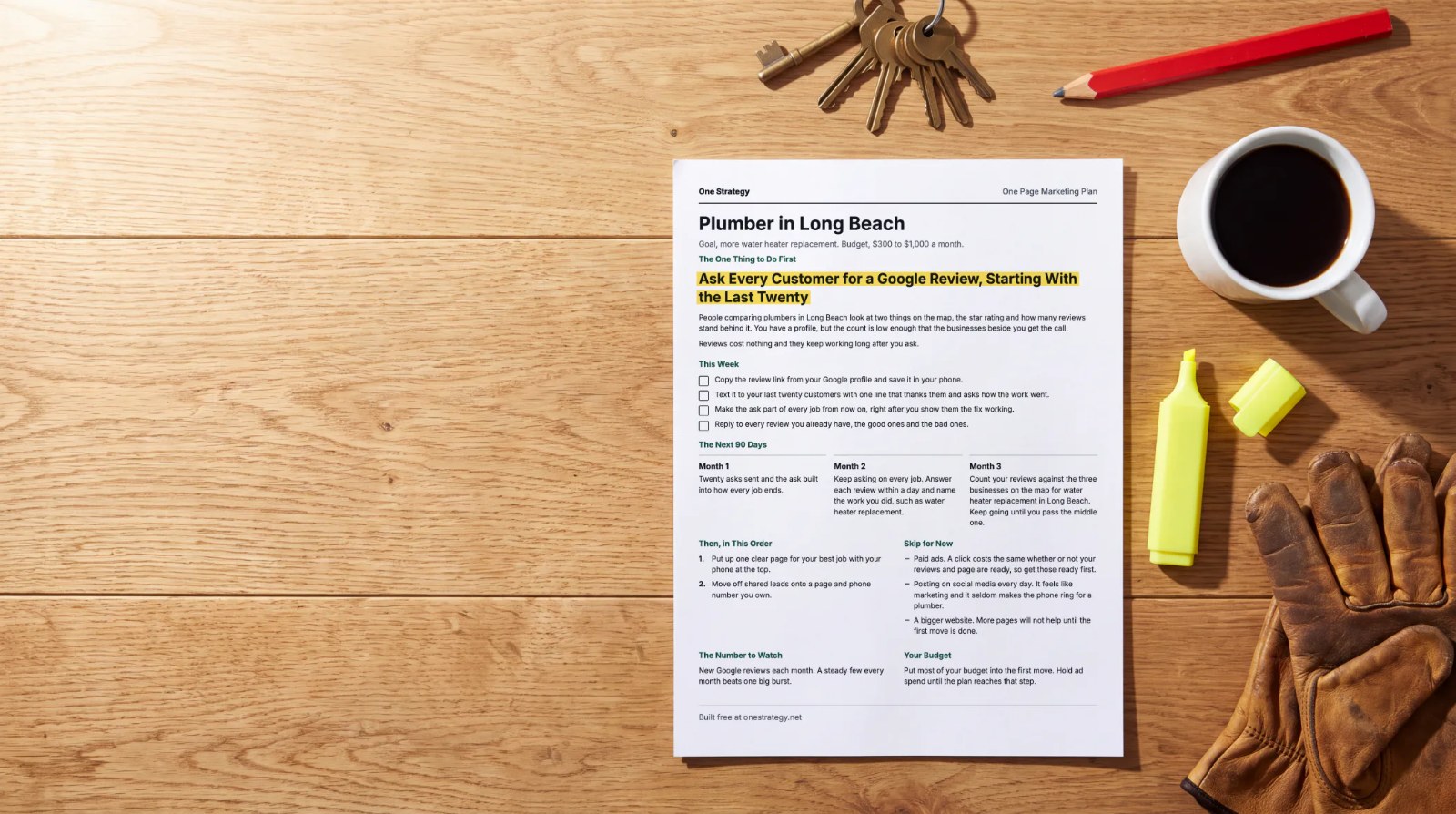
- A strategy is a choice you can say in one sentence. A plan is a schedule you can check off.
- Strategy comes first. A plan with no choice behind it grows until nobody follows it.
- For a local business the strategy is small. One job, one town and one gap to close before anything else.
- In our run of 614,400 answer sets, 82% of first moves were a Google profile, reviews or one clear page.
- The SBA says to keep a marketing plan current at least once a year. For a small shop, 90 days is a better clock.
Marketing Plan vs Marketing Strategy in One Table
The two words get swapped all the time, and that’s how a shop ends up with a binder and no direction. Put them side by side and the line is easy to see.
| Compare | Marketing Strategy | Marketing Plan |
|---|---|---|
| What It Is | One choice about where to win | The steps that carry out the choice |
| What It Answers | Which customer, which job, which gap first | Who does what, by when, for how much |
| How Long It Is | One sentence | One page |
| How Long It Lasts | Until the gap is closed | This week and the next 90 days |
| What Changes It | A new job, a new town or the gap closing | A missed date or a number that won’t move |
| A Plumber’s Version | Win water heater jobs in Long Beach by passing the middle shop on the map in review count, and skip ads until then | Text the review link to the last twenty customers this week, ask on every job, count against three rivals in month three |
| How It Fails | Trying to win everywhere at once | Twelve tasks and time for one |
The plumber row comes from a real sheet the builder printed. You’ll see the whole page further down.
Strategy Is the Choice of What to Skip
Michael Porter put it in one line in Harvard Business Review in 1996. “The essence of strategy is choosing what not to do.”2 A strategy that gives nothing up is a wish list.
Most write-ups on this topic reach for Nike or Starbucks to show what strategy means. That’s no help when you run two trucks. For a company with a marketing department, the choice is about markets and product lines. For you it’s smaller and sharper. Which job do you want more of, in which town, and which one gap do you close before you touch anything else?
The SBA draws the same line from the other side. Its marketing guide puts the core of your marketing strategy inside your business plan, and it describes the marketing plan as the actions you’ll take to win customers.1 Strategy is the decision. The plan is the doing.
You can test yours in ten seconds. Fill in this sentence, and if you can’t fill the last blank, you don’t have a strategy yet.
For the next 90 days, your business wins more one job in one town by fixing one gap, and skips two things until that’s done.
The skip part does the heavy lifting. It’s what frees up the hours and the money for the one thing you picked.
The Plan Is Dates, Steps and One Number
The SBA lists what a full marketing plan holds. Target market, competitive advantage, a sales plan, goals for the year, an action plan and a budget.1 That’s the right list for a lender. It’s too much to run a week on.
To run a week, a plan needs four parts and nothing else.
- This week. Three or four tasks you can finish and check off.
- The next 90 days. One milestone for each month.
- One number to watch, and where you’ll read it.
- A budget line that says what the money is for and what it’s not for.
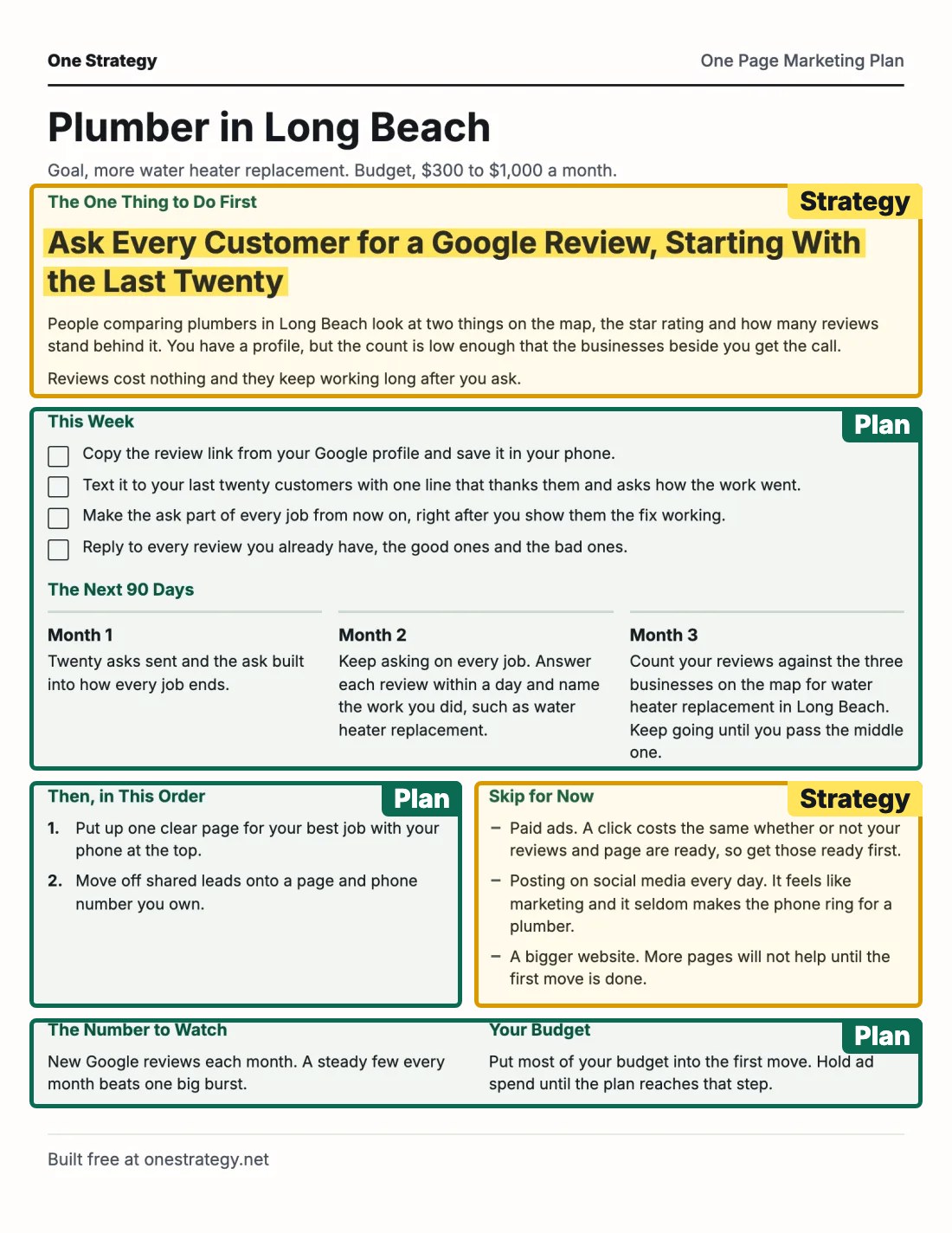
Look at how little of the page the strategy takes. Two boxes. Everything else is the plan, and every line of it serves the one choice at the top.
The number matters more than it looks. Each example sheet on this site names one number, and it’s always something you can count or look up yourself, like new reviews this month or calls from your Google profile. One number tells you if the plan is working. Six numbers tell you nothing, because you’ll stop reading them.
What 614,400 Answer Sets Put First
The builder asks seven questions, and five of them drive its rules. Twenty trades, five budget levels, four Google profile answers, three website answers and every mix of the nine lead source boxes make 614,400 answer sets. Each one went through the same rules a visitor gets, and the first move was counted.
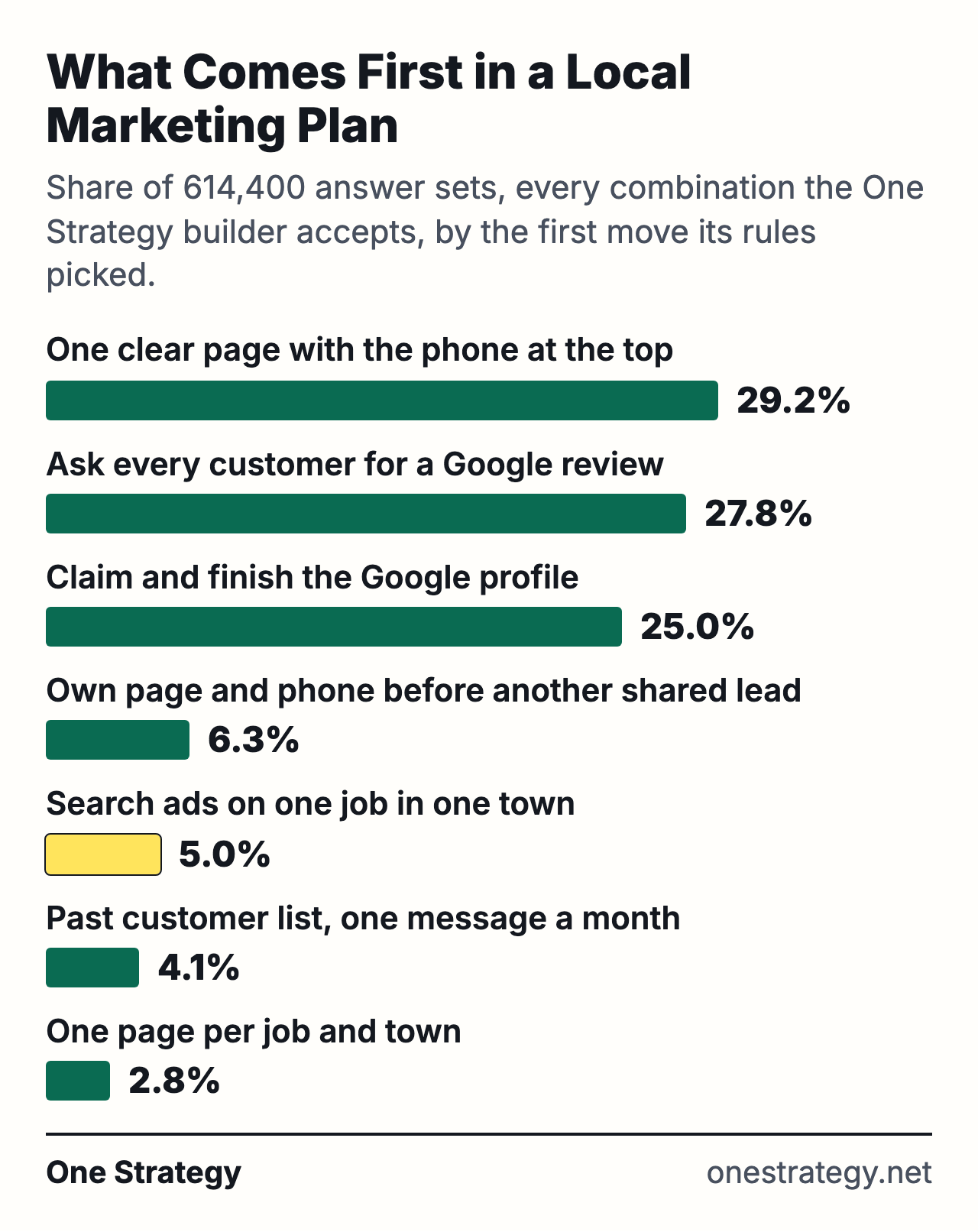
Three basics took 82% of the first moves. One clear page with the phone at the top came first in 29.2%, asking every customer for a Google review in 27.8% and claiming and finishing the Google profile in 25.0%. Search ads came first in 5.0%. Even at the top budget answer, over $3,000 a month, ads came first in 9.5%.
The skip list tells the same story. Paid ads sat under Skip for Now on 83% of the sheets.
Read that for what it is. Every answer set counts once, so this isn’t a survey of real owners. It shows how the rules lean, and the rules are the order the Clickflame team works in. The reasons behind that order come from outside this site.
Google says businesses with complete and accurate information are more likely to show up in local results, and that more reviews and positive ratings can help your local ranking.3 BrightLocal’s 2026 survey of 1,002 US adults found that 47% of consumers won’t use a business with fewer than 20 reviews. In the same survey, 83% of people who were asked to leave a review went on to leave one.4
So a strategy of reviews first isn’t the timid option. An ad click that lands on a profile with six reviews costs the same as one that lands on a profile with sixty. Nearly half the people in that survey would pass on the first one.
Eight Example Plans and the Strategy Behind Each
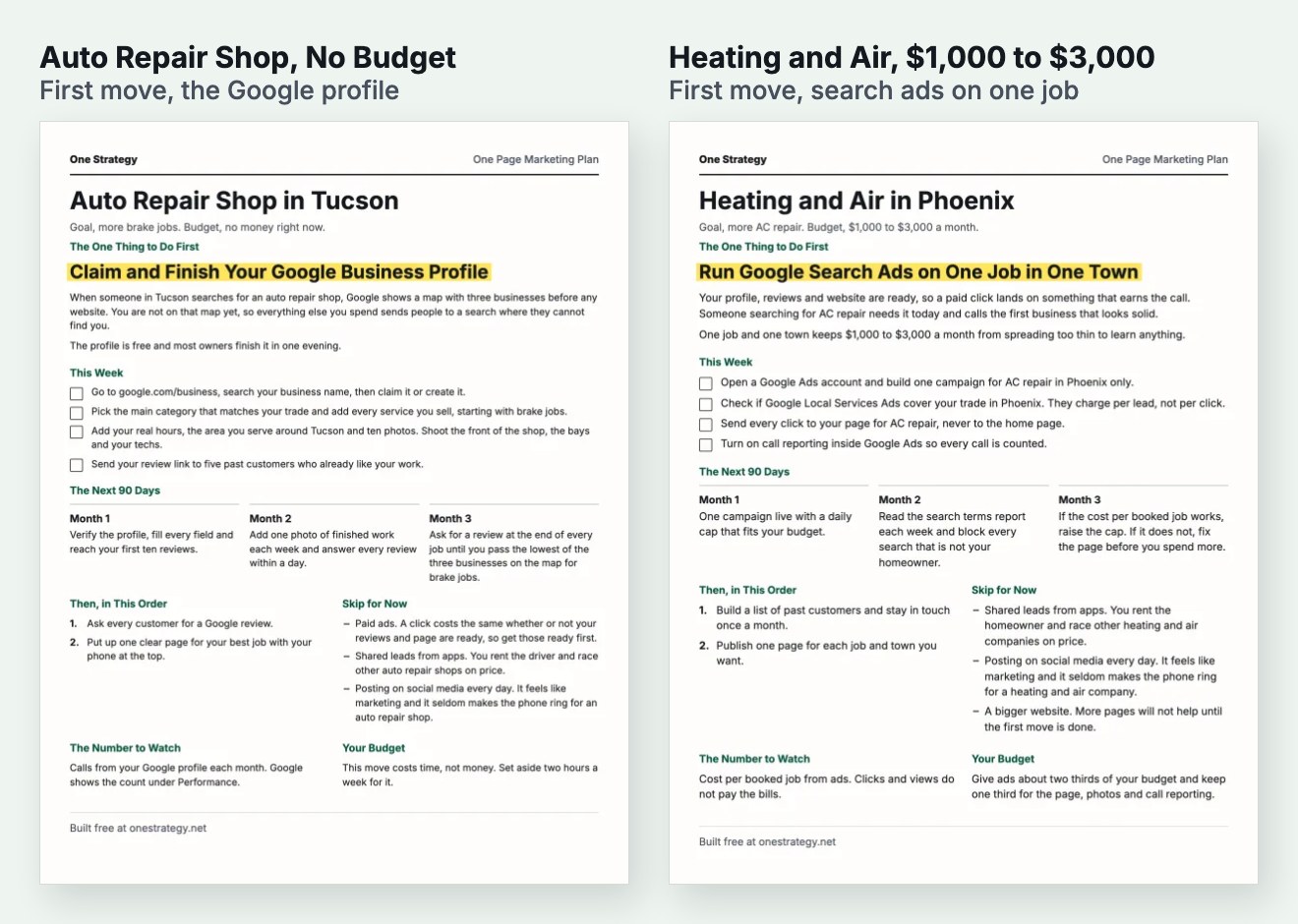
Strategy isn’t a template. The site has eight example plans, each built from sample answers a trade might give, and the first move changes with the answers.
| Business | The Strategy | The Number the Plan Watches |
|---|---|---|
| Plumber, Long Beach | Ask every customer for a Google review | New Google reviews each month |
| Roofer, Riverside | Rebuild the home page around one job, one town and one phone number | Calls and form fills from the page |
| Dentist, Fresno | Build a list of past customers and give them a reason to come back | Jobs from repeat customers and referrals |
| Auto Repair, Tucson | Claim and finish the Google Business Profile | Calls from the Google profile |
| Locksmith, Tampa | Send leads to your own page and phone before buying another shared lead | Cost per paid job, split by lead source |
| Pest Control, Plano | Publish one page for each job and each town | Clicks from Google search |
| Electrician, Columbus | Put up one page for panel upgrades with the phone at the top | Calls and form fills from the page |
| Heating and Air, Phoenix | Run Google search ads on one job in one town | Cost per booked job from ads |
The skip lists are just as telling. Posting on social media every day is on the skip list of all eight sheets. Shared leads from apps are on six. Paid ads and a bigger website are on five each.
You can open all eight example plans and read each page top to bottom. The strategy is always the highlighted line. The rest is the plan.
Write Both on One Page
You don’t need software for this. A sheet of paper works. Go in this order and don’t skip ahead.
- Write the strategy sentence from above. One job, one town, one gap.
- Under it, list two or three things you’re skipping and the reason for each.
- Write this week’s tasks. Four at most, and each one has to be something you can finish.
- Give each of the next three months one milestone.
- Pick one number and write down where you’ll read it.
- Put a date at the bottom for the day you’ll read the page again.
If the page fills up before you reach step five, your strategy is too wide. Cut a job or a town and start over.
Not sure which gap comes first? The builder checks your answers against eight rules in a fixed order and stops at the first gap. The full order is on How It Decides.
When to Change the Plan and When to Change the Strategy
Change the plan often. If you missed this week’s tasks, rewrite them smaller. If the number is flat after 90 days, change the steps and keep the choice.
Change the strategy when the gap closes. Take the plumber. Once the review count passes the middle shop on the map, reviews stop being the gap. The next line on the sheet, one clear page for the best job, becomes the new strategy, and a new plan gets written around it.
The SBA says a marketing plan should be kept up at least once a year, and that you should compare what marketing costs with the revenue it brings in.1 A year is a long time for a shop with one truck. Read the page every month. Rewrite it every 90 days.
Things Nobody Tells You
- Which comes first, a marketing strategy or a marketing plan?
- The strategy. It’s the choice of which job, which town and which gap to fix first. The plan is the list of dated steps that carries the choice out, so it can’t be written until the choice is made.
- Can a marketing plan fit on one page?
- Yes, when the strategy behind it is one choice. A one page plan holds this week’s tasks, one milestone a month for 90 days, one number to watch and a budget line. If it won’t fit, the strategy is trying to do too much.
- How often should you update a marketing plan?
- The SBA says at least once a year. For a small local business, read the page every month and rewrite it every 90 days, or sooner if the gap you picked has closed.
- Is a marketing strategy part of a business plan?
- Yes. The SBA says your business plan should hold the central parts of your marketing strategy. The marketing plan is a separate, more detailed page that turns that strategy into actions.
- Do you need an ad budget to have a marketing strategy?
- No. In the run of 614,400 answer sets through the builder, the two lowest budget answers never got ads as the first move, and every one of them still got a first move. Claiming a Google profile and asking for reviews cost time, not money.
Source Trail
- U.S. Small Business Administration, Marketing and Sales. Accessed November 2026.
- Michael E. Porter, What Is Strategy?, Harvard Business Review, November to December 1996. Accessed November 2026.
- Google Business Profile Help, Tips to Improve Your Local Ranking on Google. Accessed November 2026.
- BrightLocal, Local Consumer Review Survey 2026, published February 11, 2026. Accessed November 2026.
- One Strategy builder, all 614,400 answer sets run through its rules in November 2026. Our own count.
Tell Google You Want More From One Strategy
Follow Up Reading
- The Full One Page Plan for a Plumber
- Eight Example Plans by Trade
- The Order of the Eight Rules
- Build Your Own Plan Free
We made One Strategy at Clickflame, a marketing agency in Long Beach, California, as a free way to get your first move onto one page.